Dolly and Elise
A Partnership Built on Trust
A true story of connection, courage and what
happens when a horse feels seen.
How it started,
It’s funny how things happen, and meeting Judi and Elise was one of those moments. I was walking Dolly around the village on a Sunday morning when a family stepped out of a house and spotted us. The woman, originally from South Africa, said, “Oh please, can we take a photo? We never see this in South Africa.”
So Dolly and I stopped for an impromptu photo shoot. The dad lifted the little children onto Dolly’s bare back while his wife took pictures. I hadn’t realised that one of the boys wasn’t part of their family. Just as we were about to leave, his mum - Judi — appeared.
She said, “I wish my daughter had seen this. She rides all the time, but they won’t let her help at the school because she’s too young for the insurance.” We chatted for a bit, and out of nowhere — and she said many times afterwards that she doesn’t know where it came from — she asked, “Could Elise come and help out with Dolly?”
Even more surprising, without meeting Elise (who was 11 at the time) and despite the fact I’m not remotely maternal, I said yes.

Energy and Groundwork
When Judi and Elise arrived at the yard the following Sunday, I took one look at Elise and thought, “Oh gosh… she’s so small.”
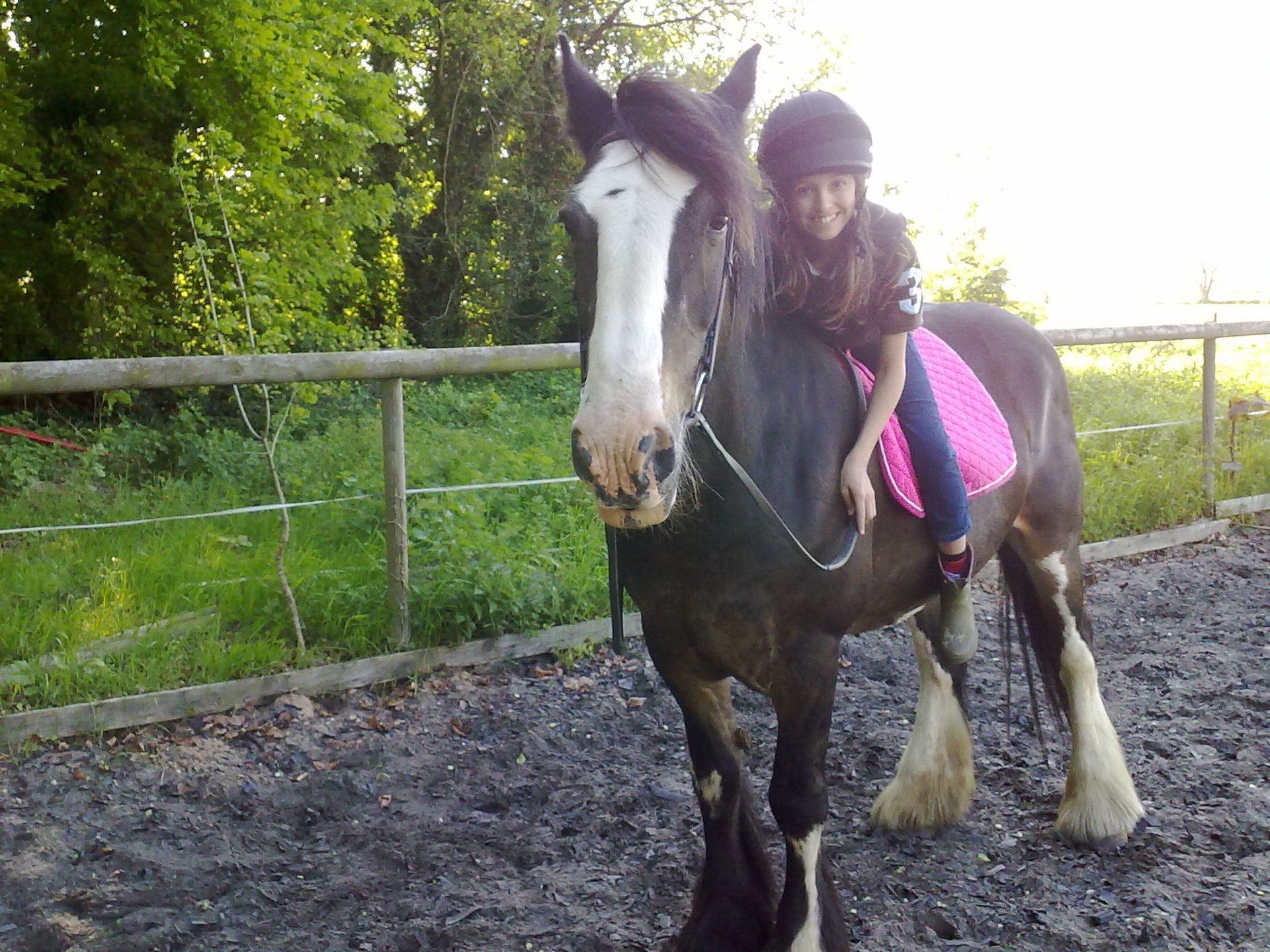
This photo was taken a few weeks later, but it shows the scale perfectly — Elise standing beside Dolly, looking like she could tuck herself under Dolly’s neck without Dolly even noticing. I later learned she weighed only four and a half stone. Dolly, at 15.3 hh and built like a tank, made her look tiny.
Because of that size difference, I said to Judi, “I think the wisest thing is to show Elise how to move her around using her energy. Then if they ever have a dispute, Elise will have the knowledge to keep herself safe.”
Judi was so intrigued by what I was saying that she didn’t just agree — she immediately asked if she could stay and watch.

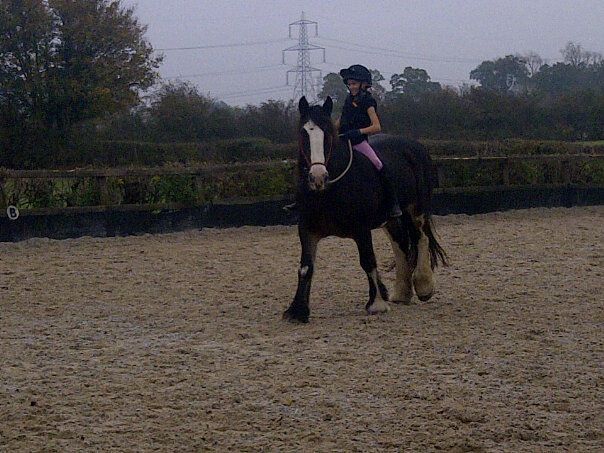
Dolly and Elise - Bareback
I soon realised Elise wasn’t just a child who liked horses.
She had a sharp instinct, a steady mind, and a natural feel for animals you simply can’t teach.
With a bit of groundwork under her belt, she and Dolly were becoming genuine friends.
It wasn’t long before she persuaded both me and her mum to let her ride Dolly bareback.
My saddle didn’t fit her anyway — her legs were far too short — and she actually sat more securely without it.
So she rode in a natural horsemanship halter with a single 12-foot rope clipped at both ends as reins.
No bridle. No “handles.” Just balance, intention, and trust.
That first ride told me everything.
She didn’t rush. She wasn’t trying to “achieve” anything. She simply walked Dolly around the arena, talking to her, stroking her, enjoying being up there.
Yes, the size difference was obvious — tiny Elise on my broad, powerful mare — but the bigger truth was this: Dolly trusted her.
It became a learning curve for all of us.
Elise wasn’t intimidated by big horses or responsibility, and I wasn’t used to guiding someone so young.
We were all learning each other’s language as we went.
Cheek or Communication?
In this video you see Dolly give a couple of small, gentle hops at the start. Elise sits them beautifully — balanced, calm, and trusting Dolly not to overreact.
Those hops weren’t bucks or “testing.”
They were Dolly’s way of saying:
“You’re asking me to go forward, but you’re holding me at the same time.”
Elise had a light feel on the rope — not a lot, but just enough to give mixed signals. I also didn’t appreciate at the time that a natural horsemanship halter, with thinner rope and pressure points, can amplify even small contact.
That was a lesson for me later:
in trying to avoid the impact of traditional riding techniques, I’d accidentally created a different kind of pressure. A mistake made with good intentions — the kind that happens easily when we’re trying to improve things but aren’t given the full truth about the equipment we use.
As soon as I asked Elise to soften her reins, Dolly relaxed instantly and moved forward freely.
You can see the rope loosen when she settles into the trot.
Dolly wasn’t being “naughty.”
She was communicating.
And the moment the message was heard, everything improved — because Dolly wasn’t unwilling. She was confused about what was being asked, and it wasn’t long before that little girl had that horse cantering round that arena on both reins.
This is exactly the foundation of what I now teach through Dolly Communication:
that trust-based horsemanship, clear boundaries, and listening without ego create safer, calmer, more connected partnerships for both horse and human.
The Day Dolly Bolted — and Chose Connection Over Panic
One morning, Judi and I walked down the road with Elise so she could have a short hack on Dolly. She just about managed the saddle that was necessary for the road.
She trotted back and forth in front of us, staying in sight, riding calmly and confidently.
When we reached a field track, I told her she could have a canter — but to stay visible. Just as she set off a bird-scarer exploded behind the hedge.
It made us all jump.
Dolly shot forward.
If I’d been riding, loose reins would’ve given her the room to process the noise and work out she was safe. Elise had contact — exactly what she’d been taught at a standard riding school — and pulling was the only tool she knew in that moment. Dolly, already startled, felt that pressure as pain in her mouth, and it intensified her fear.
As Dolly disappeared up the track, I could see Elise was unbalanced and now a passenger. I shouted, “Ease your reins!” because reducing the pressure would give Dolly a chance to reset.
And then Dolly heard my voice.
Everything changed in that moment.
Instead of running blindly on, Dolly turned — a huge, sweeping arc across the field — heading back towards me until she could see me clearly. She slowed into a fast, frightened trot, Elise hanging on incredibly well, doing everything she could to stay balanced while beginning to soften her hands.
Dolly’s eyes were locked on me the whole time.
I kept my voice low and steady:
“Good girl, Dolly… steady…”
Elise regained her seat, and Dolly powered right up to me and stopped. She was blowing hard, wide-eyed, adrenaline still pouring through her. Judi went straight to Elise, who was shaken but safe. I stood with Dolly, breathing slowly so she could follow my rhythm and start to relax, calming the adrenaline still pumping inside her..
I’ve never known another horse spook, bolt… and then loop back towards the place where the frightening sound came from — simply to get to their person.
But that was Dolly.
Confused, frightened, but still searching for connection as her safest option.
It remains one of the clearest demonstrations of trust I ever saw.
And clear proof to me that “control” — the way it’s often taught — doesn’t guarantee safety. In fact, it often adds pressure at the worst possible moment.
That was the only time Dolly bolted in the ten years I owned her.
And Elise?
Elise did a splendid job that day. She rode with remarkable instinct and balance. Most riders get left behind when a horse bolts — the momentum throws them backwards, they tense up, and the panic makes a fall far more likely.
Elise did the opposite. Even though she was initially left behind, she stayed composed, kept her body soft, and worked her way back into the saddle. That’s why she stayed on. She was as natural in the saddle as she was on the ground — an extraordinary little horsewoman. it was my pleasure to watch.
The Dressage Competition:
Confidence and Partnership Built Through Trust-Based Horsemanship

How the "dangerous little girl on a big horse" proved them wrong.
Some ladies from the yard were talking about supporting a local charity dressage competition, and for fun we decided to enter Dolly. She was entered in three tests: the walk–trot with me, the walk–trot again with Elise, and the prelim with my dear friend Julia — someone who was also an important part of Dolly’s life.
As far as I know, Dolly had never been in a competition before. Elise and I certainly hadn’t. Thankfully, Julia had and on the day she handled the entries, numbers, and all the bits that feel overwhelming when you’ve never done this sort of thing before like a pro. She was a star!
We each practiced in the weeks beforehand and hitched a lift with a lovely lady from our previous yard.
I was the first one to ride. Dolly was an absolute angel — all the mounting issues we’d struggled with in the past were forgotten. She stood quietly, set off willingly, and did her best for me, I was now a nervous rider and worried her powerful trot would roll into canter and I’d fall off. Even so, we scored 57% in the walk–trot. Respectable, considering I rode half the test like I had the handbrake on.
Afterward I went to help Elise warm Dolly up in the collecting ring. Elise rode a beautiful, forward working trot — the kind you see and think, wow, that horse feels good today. But when she came back to me, her face had changed.
In that quiet little voice of hers she said she didn’t want to warm up anymore.
Eventually I got it out of her: another rider had seen her and said,
“Little girl on a big horse. Dangerous.”
My heart dropped. Elise was willful, yes — but she was also very delicate. And she adored Dolly. That comment had landed right where it hurt.
I told her firmly,
“You did a beautiful working trot. You are not dangerous. Go and warm your horse up.”
With a bit of encouragement, she pulled herself together, rode back into the space, and quietly did exactly that.
Then she went into the arena and won the walk–trot.
Over 60%.
Eighteen competitors.
All adults on their own horses.
And she beat me and Dolly into fifth place — she was a much better rider.
It was one of the proudest moments of my life. Not because of the rosettes, but because Dolly carried her with such kindness, and Elise rose above something that would have crushed a lot of adults.
The trust between them was real, and everyone watching could see it.
Time Moves on
Shortly after that day, Elise started getting regular offers to ride other people’s horses. She was talented, kind, and quiet in her approach — exactly the sort of child every mother wants around their own child's "naughty" ponies.
It was good experience for Elise and her mum wasn't one to hold her back. I knew there were many different ponies out there that could use Elise's kind heart.
Around the same time, I moved Dolly to a yard closer to my new job, but in the opposite direction from where Elise lived. This was a necessity I couldn't avoid and I understood this would change the way Elise could visit, It increased the distance and the time for her mum and Judi was a busy lady in her own life.
Visits naturally became fewer.
I was sorry to break up the union but we all understood life changes and Elise was growing up. Her challenges moved on as is right. Nothing stays the same forever.
When they did come to visit, though, nothing had changed.
Dolly still lit up for her.
Elise still rode with the same softness, the same instinct, the same joy.
They would spend their time playing with little jumps, racing around "barrels", and finding their own games — just as they always had. And I never once worried about them together. Whatever that small, determined girl wanted to try, I knew Dolly would keep her safe.
That trust between them never faded.
Years Later

Another yard later,
Dolly and I were both older, both dealing with health issues.
Now we were even further away and Judi and Elise had not visited the new yard. It was a natural ending. No animosity, just life and circumstances moving on.
We had been at this new yard a couple of years and Dolly was much happier than at the previous one.
That yard had been wrong for her and she had been stressed while she was there. Here we were settled into a quiet routine both growing older and slower. It seemed the right thing, but Dolly still had lessons for me.
One day I was doing jobs while Dolly munched her hay. She heard a young girl laughing somewhere on the yard. Dolly came to the stable door with her ears pricked — a spark I hadn’t seen for a while. She followed the sound around the stables, and when the girl came into sight, Dolly recognised her. And I watched the brightness fall away as Dolly realised it wasn’t Elise. She turned back to her hay slowly, and I could see disappointment in her whole body. .
That was when I realised how much she missed her little friend.
I reached out to Judi, who said they’d been thinking of us too. We were a lot further away now but Judi said they would love to see Dolly again and agreed to bring Elise over one more time.
Elise had grown into a tall, elegant young woman. I was surprised myself how she had shot up. I deliberately left Dolly in the field so that Elise could fetch her in.
When we went through the gate, Dolly looked towards us, confused. She could hear Elise’s voice but couldn’t match it to the grown girl in front of her. I handed Elise the headcollar and said, “Go and fetch her.” Judi and I watched as they walked towards each other. Dolly was clearly puzzled by Elise’s height. Judi caught the moment they recognised each other properly — a beautiful shot of them head-to-head after all those years.
It was lovely to see. Elise had always brought fun, youthful energy to Dolly, and Dolly found that spark again. We tacked up and Elise took her into the bottom field, popping over little jumps. Dolly was about 19 by then. She’d been slowing down, stiffening, showing her age. But that afternoon she was young again. Back with her young friend.


A Quiet Reflection
That afternoon, Dolly showed me things I hadn’t fully understood before — about horses, relationships, and energy.
I saw that Dolly had grown old alongside me. It wasn’t that she didn’t want to carry me; as she aged, my weight simply became too much for her. I was more than twice the weight of even a grown Elise. With that light body on her back, Dolly could be young again.
I also saw how deeply horses bond with humans, and I felt a quiet sadness that I had separated these two for so many years. When Dolly first showed interest on hearing a young girl on the yard, I thought it was simply the brightness of youth she was responding to. But when that girl came into view and it wasn’t Elise, I saw the disappointment pass through her whole body.
The day Elise visited, Dolly lit up in a way I hadn’t seen for a long time. And in that moment I realised something uncomfortable: Dolly had adapted herself to me — a steady, nervous, older woman — just as she had once adapted to Elise.
That is what horses do.
They shape themselves around the humans in their lives. They meet us where we are. But inside, they remain the vibrant animal they have always been.
The Dolly I saw that afternoon was older, yes — but she was also alive, playful, engaged. With me, she carried weight and caution. With Elise, she carried joy and fed from her energy.
We buy and sell horses. We move them from place to place, herd to herd, human to human. We rarely consider the relationships they leave behind — with other horses, with people, with familiar routines and safe patterns. We expect the horse that steps off the lorry to be the same horse we rode somewhere else, as though nothing has been lost along the way.
But horses grieve change. They have to learn new environments, new humans, new rules, and form new relationships — all while their nervous systems are already stretched. And yet we often expect them to perform immediately, as though they were machines rather than living beings processing loss.
This isn’t anthropomorphising horses with human emotion. Horses share the same vagus nerve and nervous system design as we do. Their senses are sharper than ours — not duller. So it makes no sense to assume their emotional world is smaller.
Relationships are not an extra for horses. They are as fundamental as breathing and movement.
That day, I learned something simple and sobering: owning a horse is not an entitlement. It is a responsibility — to build a relationship that makes them feel safe, seen, and included in a circle of trust.
Because the one thing horses never do is lie.